How much light do you need when the power is gone?
A simple way to size lighting for shelters, assembly points and shared spaces
All articles
-
![Joona Cichy sits next to some of the SunTurtle solar lamps he bought for donation to learners in Ghana and Madagascar through his Bright Futures ngo]()
- Stories
- Humanitarian
Bright Futures: How a 16-year-old is donating solar lamps to help learners study after dark
In Cologne, Germany, December darkness settles early. Most students move from school to after-school clubs and switch on their desk lamps without a second thought. Yet for millions of children elsewhere, nightfall closes the school day altogether. This contrast prompted one student to act.
Read more
-
![BRIGHT Products was one of the top 5 finalists in the inaugural UNIDO ONE World Sustainability Awards' Women in Industry category]()
- News
BRIGHT honoured as global finalist at inaugural UNIDO ONE World Sustainability Awards
BRIGHT has been recognised by the United Nations Industrial Development Organization (UNIDO) as one of the five global nominees in the Women in Industry category of the inaugural UNIDO ONE World Sustainability Awards. The nomination places BRIGHT among a select group of organisations shaping more inclusive and sustainable industrial practices.
Read more
-
![]()
- Sustainability
- News
BRIGHT publishes Environmental Product Declarations for SunBell 2.0, Sol Mid Capacity solar lamps
As part of our commitment to sustainability, BRIGHT is proud to announce the publication of the Environmental Product Declarations (EPDs) for our SunBell 2.0 and Sol Mid Capacity solar lamps. These EPDs provide customers, procurement officers, and partners with independently verified data on the environmental footprint of our products.
Read more
-
![A shipment of BRIGHT solar lamps being loaded from one of our warehouses in China]()
- Insights
Humanitarian logistics: How we ensure reliable lead times in emergency procurement
BRIGHT has delivered over 4.3 million pico-solar products to more than 60 countries, reaching communities in crisis zones, refugee camps, and remote off-grid areas. Behind this achievement is an innovative humanitarian logistics system that combines data-driven planning, sustainable packaging, and trusted global partnerships. With hubs in China and Norway, BRIGHT ensures solar lamps and energy solutions reach those who need them most – quickly, reliably and responsibly.
Read more
-
![BRIGHT solar lamp Repair Program in Bidibidi Uganda. Group photo of E-waste Management project participants, featuring representatives from BRIGHT and IOM (© BRIGHT).]()
- Stories
- Sustainability
- Field work
- Humanitarian
- Repair
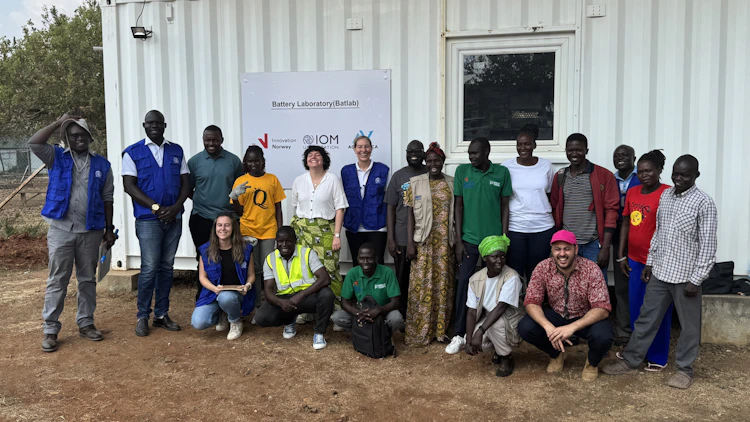
BRIGHT’s solar lamp Repair Program: A circular economy model for humanitarian e-waste
In Uganda's Bidibidi refugee settlement, the International Organization for Migration (IOM) leads a multi-stakeholder e-waste management project that Norway's Innovation Norway and IOM's own reporting to the UN describe as the leading e-waste initiative in the humanitarian sector — the first comprehensive circular economy model tested in a displacement setting. At its centre is BRIGHT's solar lamp Repair Program, which trains local technicians to turn e-waste into opportunity through repair, refurbishment and battery recovery. Since the project launched in 2022, technicians have collected 11,650 solar lamps, repaired and returned 9,379 to use, and recovered over 20,000 lithium-ion cells for reuse in second-life battery packs. By combining circular economy principles, community ownership and a direct feedback loop into product design, the Repair Program offers a working model for e-waste management in displacement settings — aligned with Sustainable Development Goals 7 (Affordable and Clean Energy) and 12 (Responsible Consumption and Production).
Read more
-
![Image of the upgraded SunBell 2.0Y solar panel made with 100% post-consumer recycled (PCR) plastic and the Sol solar lamp with the new, lighter and more efficient monocrystalline solar panel using Ethylene Tetrafluoroethylene (ETFE) plastic. Two latest innovations showcasing BRIGHT's approach to using circular product design to tackkle plastic pollution]()
- Insights
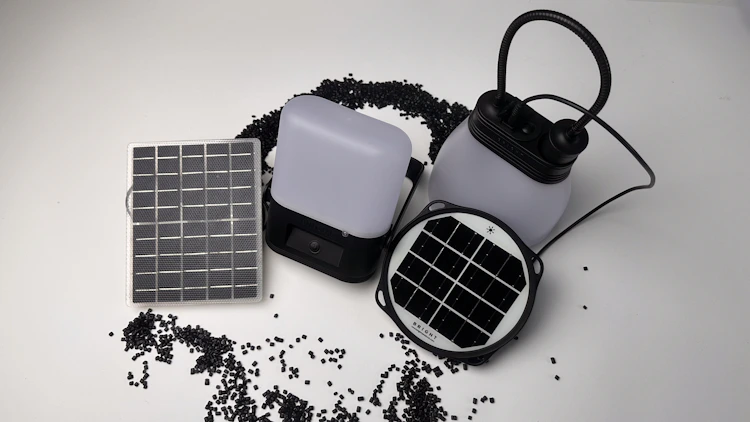
Tackling plastic pollution through circular product design, BRIGHT’s approach
The United Nations Environment Programme (UNEP) estimates that globally more than 400 million tonnes of plastic is produced annually. Half is used once and discarded, with less than 10% recycled. Around 11 million tonnes end up in water bodies annually, imposing a global environmental and social cost of between US$300 billion to US$600 billion.
Read more
-
![BRIGHT solar lamp for emergencies glowing in a dark indoor space, ideal for emergency kits during power outages or severe weather.]()
- Insights
- Emergency Preparedness
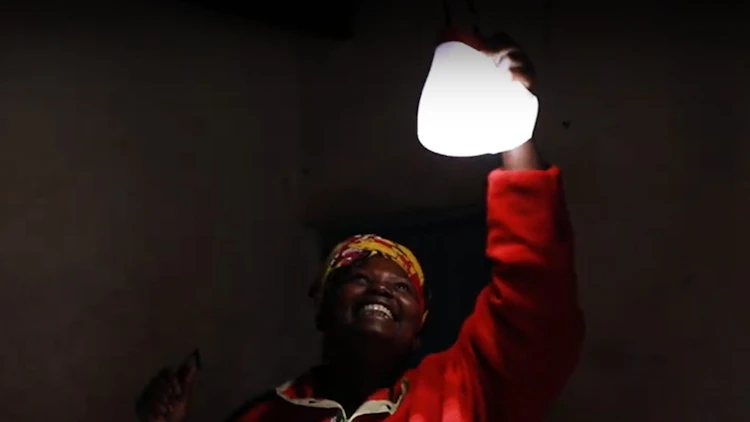
How to choose the best solar lamp for emergencies
Power outages are a predictable feature of modern crises. Storms, floods and grid failures often cut electricity when it is needed most. For governments, aid agencies and households, a dependable solar lamp has become an essential part of emergency preparedness. The right lamp can provide safety, light critical spaces and keep basic communication running when the power goes out.
Read more
-
![BRIGHT designs solar lamps to provide light that balances brightness and colour temperature]()
- Insights
Lighting the way: How BRIGHT designs solar lamps for comfort & efficiency
Behind every solar lamp we create lies a critical design philosophy: real-world use must shape technical choices. The light emitting diodes (LEDs) in our solar lights are meticulously engineered to provide optimal brightness and appropriate colour temperature. Explore how we choose brightness and colour temperature in our solar lamps, and why those decisions matter for the people we serve.
Read more