Solar lighting for emergency shelters: Field insights from Ukraine
In summer 2025, BRIGHT deployed 710 solar lamps across Ukrainian emergency shelters, schools and displacement settings. Field monitoring data from Kharkiv shows how solar lighting supports safety, mobility and education continuity in conflict-affected environments.
In summer 2025, underground bomb shelters, school basements, and displacement transit centres across Kyiv, Kharkiv and Kherson were operating without reliable electricity. In Kharkiv – close to the frontline – shelters faced repeated, unpredictable outages and infrastructure disruption. In Kherson, chronic grid instability had made power cuts a daily reality. In Kyiv, air raid alerts sent pupils and teachers underground, sometimes for hours at a time.
BRIGHT funded and deployed approximately 710 solar lamps across these locations in partnership with three Ukrainian civil society organisations: Smart Kids in Kyiv, Support Kherson in Kherson, and the Relief Coordination Centre in Kharkiv.
This was not a controlled trial. It was an operational response to an active need, carried out in conditions that test equipment more honestly than any laboratory. This article documents the field data, what it shows about product performance, and what procurement specialists in humanitarian aid and emergency preparedness should take from it.
Factbox
-
Local partners
Smart Kids; Support Kherson; Relief Coordination Centre
Locations Kyiv; Kharkiv; Kherson Number of lamps deployed 710 Products deployed
Sol Mid Capacity; Sol High Capacity; Move; Start+ Monitored products Sol High Capacity, Move Monitored sites Two shelter locations in Kharkiv Monitoring period Late June to early August 2025 Use cases - Displacement shelter lighting
- Transit centre lighting
- School shelter lighting
- Children's learning activities
- Emergency preparedness


Why solar lighting should be part of emergency shelter infrastructure
For humanitarian and emergency preparedness teams, shelter lighting is a basic operational enabler, not a comfort item. When shelters, transit centres, schools, and collective sites face electricity interruptions, the absence of reliable light affects safe movement, distribution activities, communication, children’s learning, social interaction, and the perceived safety of the space.
Prior to deployment, shelters in these locations relied on a mix of flashlights, mobile phones, and, where available, fuel generators. Each carries significant limitations in a protracted emergency. Phone lights drain batteries needed for alerts and communication. Disposable-battery lighting creates replenishment and waste problems. Fuel generators require fuel, maintenance, ventilation, and safe operation.
The scale of need at some sites was considerable. Katherina Lavrenko, coordinating frontline humanitarian aid for the Relief Coordination Centre in Kharkiv, noted that transit centres in the region typically handled around 200 internally displaced people per day, with approximately 30% staying overnight.
"Thanks to the solar lamps, the conditions for the evacuees who stayed overnight were significantly improved."
- Katherina Lavrenko, Relief Coordination Centre, Kharkiv
"This is the first time we have lighting that we do not have to worry about during every blackout."
- Shelter coordinator, Kharkiv
BRIGHT's Ukraine deployment demonstrates why portable solar lighting should be considered part of emergency shelter infrastructure, particularly where grid reliability cannot be assumed. Solar lamps can be stockpiled, moved, charged through multiple methods, and monitored after distribution using straightforward field forms.
Emergency lighting conditions in conflict-affected Ukraine
At the time of deployment, Ukraine’s shelter network presented distinct and demanding conditions for solar lighting equipment.
In Kharkiv, close to the frontline, shelters were operating in a city affected by repeated outages and infrastructure disruption. In Kherson, sustained infrastructure damage had created chronic grid instability. In Kyiv, further from active ground combat but still subject to missile and drone alerts, schools maintained underground shelter facilities where children and teachers could spend extended periods during air raid warnings.
Across all three cities, shelter populations shared common challenges:
- Electricity supply was absent, intermittent, or unreliable.
- People spent extended periods underground or in enclosed shelter spaces
- Emergency lighting was frequently battery-dependent, insufficient, or difficult to maintain
- Children were present in environments where stable light directly affected safety, education, and psychological wellbeing
OCHA’s 2025 Humanitarian Needs and Response Plan documents the destruction of homes, schools, hospitals, and energy systems as part of the crisis context; subsequent situation reporting noted that outages disrupted heating, water, and healthcare services. The deployment addressed both immediate emergency needs and longer-term preparedness requirements.


Sol, Move solar lamps: Fit for emergency shelter procurement
The deployment used a mixed-product approach rather than relying on a single lamp type – which matters for procurement, since different shelter areas require different lighting profiles.
Sol High Capacity provided long-runtime, ambient lighting for shared spaces. Its 360-degree light distribution and hanging and wall-mounting options make it suitable for corridors, rooms, and communal shelter areas.
- Maximum brightness of 300 lumens (lm)
- Runtime of up to 580 hours (about 24 days) on low mode, 140+ hours on medium, 30+ hours on high, and 12+ hours on maximum output
- 23.04 Wh LiFePO₄ battery rated for 2,000 charge cycles
- Dual charging support: solar panel or 5W USB/wall charger
- IP64 ingress protection rating
- Phone and low-voltage device charging capability
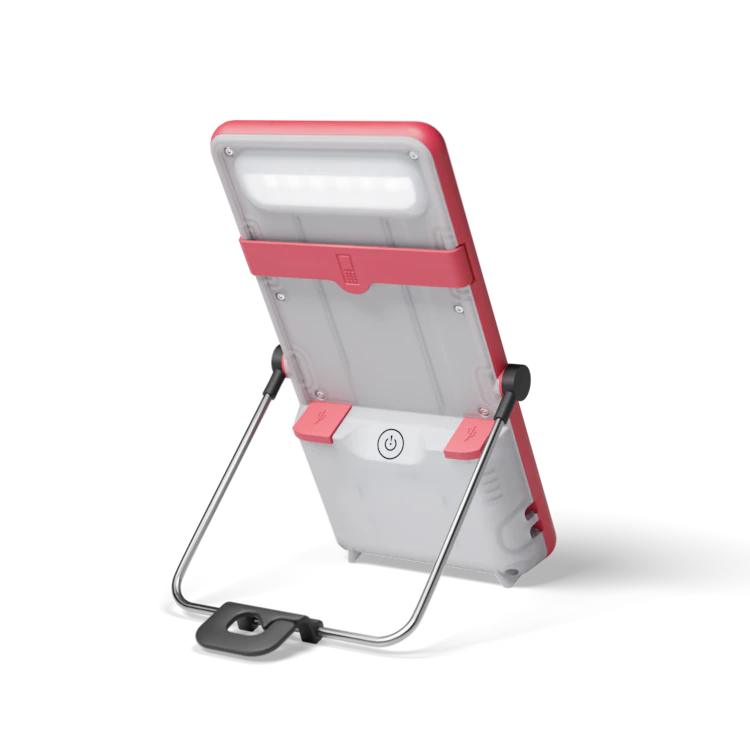
Move served as a flexible portable lamp for shelter staff, families, and residents who needed light that could be carried, repositioned, or used as a backup power source.
- Maximum brightness of 200 lm
- Runtime of 40+ hours on low mode, 10+ hours on medium, and 5+ hours on high
- 11.52 Wh LiFePO₄ battery rated for 2,000 charge cycles
- Dual charging support: integrated solar panel or USB/wall charger
- IP64 ingress protection
- Phone and low-voltage device charging capability


Field performance: Kharkiv Automobile and Road Technical College shelter
The Kharkiv Automobile and Road Technical College dormitory shelter was used as a temporary shelter for internally displaced people. A total of 15 BRIGHT lamps were monitored at this location: ten Sol High Capacity units and five Move units. The weekly forms tracked serial numbers, room or zone, light mode, average daily use, charging method and duration, brightness, runtime satisfaction, and maintenance condition.
Sol High Capacity performance
Sol High Capacity units at this shelter were mostly used in the low (5 lm) and medium (20 lm) light modes. Average daily use was recorded at three to four hours across monitored weeks, with charging duration recorded at approximately eight hours. Brightness was rated good to excellent at the start and end of each week in reviewed reports. No physical damage or mechanical issues were recorded throughout the monitoring period.
For procurement teams, this demonstrates Sol High Capacity operating as a stable, predictable shelter lighting source. Its value in this context was not only output, but also its ability to deliver consistent light across repeated use cycles without maintenance intervention.
Move solar lamp performance
Move solar lamps at the same shelter were recorded with average daily use ranging from three to six and a half hours across monitored weeks. Residents treated the lamp as a flexible ambient and task light, moving it around the shelter as needs changed. Lamps were used across multiple modes, including medium (80 lm) and high (200 lm), with charging durations ranging from approximately three hours via wall charger to eight hours with solar charging. No mechanical issues were recorded.


Field performance: Kharkiv Transit Centre shelter
The Kharkiv Transit Centre shelter served displaced people passing through the city. Sixteen BRIGHT lamps were monitored at this location: eight Sol High Capacity units and eight Move units.
Sol High Capacity performance
Across both monitored reporting periods at the Transit Centre, Sol High Capacity units were not recorded as having been charged, and brightness was rated excellent at both the start and end of each weekly reporting period. We believe this reflects low lamp usage during the summer period rather than a claim about battery endurance – with limited overnight demand at the site, lamps were likely used in the low setting and were still carrying an initial charge when the monitoring forms were completed. Daily usage data from this site is therefore inconclusive and we have not drawn performance conclusions from it.
What the data does confirm is that all eight units remained in excellent condition throughout the monitoring period – no physical damage, no mechanical faults, and no port or panel issues recorded across either reporting period.
Move performance
Move units at the Transit Centre were recorded with up to ten hours of average daily use in the low (20 lm) and medium (80 lm) settings in the later reporting period, with USB charging of approximately three hours. The ten-hour daily use figure is worth noting from a procurement perspective. Move is designed as a portable lamp, but in this transit setting it was used for extended shelter lighting – well beyond its nominal role. That finding supports its value in mixed lighting kits where portability, USB charging, and phone-charging capability are operational advantages.
Field learning: Solar charging does not work through glass
One of the clearest operational findings from the Kharkiv monitoring forms concerns charging practice. Users noted on multiple occasions that panels placed behind glazing produced no effective charge. Direct, unobstructed sunlight is required. This is not a product defect – it reflects standard photovoltaic physics – but it has direct operational implications.
This is highly relevant for underground shelters, basements, classrooms, and transit centres where outdoor access may be limited or where windows are the primary interface with daylight. For procurement officers, the implication is clear: solar lighting procurement should include deployment guidance, not just product delivery. A basic handover protocol should explain where panels should be placed, how long lamps should be charged, how to rotate units, when to use USB backup charging, and why charging behind glass is ineffective.

User feedback: Safety, comfort, and mobility
Five shelter residents in Kharkiv completed anonymous satisfaction surveys rating their experience of BRIGHT solar lamps across seven categories, on a scale from 1 (very dissatisfied) to 5 (very satisfied). Results are based on five survey responses collected during the deployment.
| Category | Question | Average / 5 (n=5) |
| Brightness | Q1 | 4.8 |
Colour temperature | Q2 | 4.8 |
| Amount of light in the shelter | Q3 | 4.6* |
Feeling safe during power cuts or alerts | Q4 | 4.6 |
| Comfort and atmosphere | Q5 | 4.8 |
| Usefulness for children studying, reading, or playing | Q6 | 4.6 |
| Overall satisfaction | Q7 | 5.0 |
* The lower score for Q3 on amount of light in the shelter (4.6/ 5) reflects one respondent who scored this category at 3/5, suggesting the lamps did not fully cover all areas of their shelter space. This indicates that even when individual lamps perform well, deployment density requires planning; room size, ceiling height, wall reflectivity, and occupancy should inform the number and type of lamps procured.
The written response show that the lamps were valued not only as technical equipment but as a source of reassurance and normalcy in difficult conditions.
“It has become more comfortable to be in the shelter. Thanks to the mobility of the lamps, it is possible to move around freely.”
- Female, 37, Kharkiv
"I feel safe in an illuminated room.”
- Female, 37, Kharkiv
“Light gives a feeling of calm, harmony, warmth and family comfort. Thanks to the lighting, I have the opportunity to live fully even in the evening.”
- Female, 37, Kharkiv
“It became much calmer.”
- Male, 27, Kharkiv


Solar lighting for school shelters in Kyiv
Kyiv presented a different use case. While the city was not facing the same proximity to active frontline combat as Kharkiv and Kherson, missile and drone alerts required schools to move pupils to underground shelters – sometimes for extended periods. Smart Kids distributed Start+ , Move, and Sol Mid Capacity lamps to shelter facilities across Kyiv schools.
In this context, solar lighting was not only about emergency response. It supported continuity of education: reading, drawing, writing, and maintaining classroom routines during shelter periods. Teachers reported meaningful improvements in classroom functionality during alert periods, noting that students were able to read, draw, and write without the strain of using flashlights or mobile phone lighting.
Smart Kids reported that Sol Mid Capacity lamps averaged approximately 15 hours of runtime before recharging was needed. Based on that figure, lamps were likely being used primarily in the high light setting (100 lm) – consistent with a classroom environment requiring sustained light for reading and writing. Start+ was noted as particularly well suited to younger children, who found its form factor easy to handle and use independently.
“We managed to get through the winter thanks to your lamps, and the children truly felt safer because of them. We would be very grateful if you could send more lamps, so that we can also provide them to other schools. Another difficult winter is ahead of us, and the need is still very high.”
- Yevhen Stepanenko, Director, Smart Kids, Kyiv
This Kyiv use case matters for procurement officers because it illustrates the difference between acute emergency relief and protracted preparedness. Children may not be displaced in the same way as people passing through a transit centre, but repeated disruption to education creates a sustained need for reliable, rechargeable lighting that does not depend on batteries or mains power.


Procurement findings from the Ukraine deployment
The deployment provides practical evidence for procurement teams evaluating solar lighting for emergency shelters, displacement centres, and preparedness stockpiles. The clearest lesson is that emergency lighting should be procured as infrastructure, not as an ad hoc item. That means selecting products with verified runtime, sufficient battery capacity, durable construction, flexible charging options, and a form factor matched to how people use light in shelters.
It also means planning beyond the purchase order. A complete solar lighting deployment should include:
- A target lamp ratio based on shelter size and occupancy
- Guidance on charging routines and panel placement
- User instructions in the local language
Battery capacity determines operational burden
In shelter settings, battery capacity determines how often staff need to collect, charge, rotate, and check lamps. Sol High Capacity’s long runtime and 23.04 Wh LiFePO₄ battery are especially relevant in locations where power access, daylight access, or staff capacity is limited – fewer recharge cycles mean less management burden on already stretched shelter teams.
Charging logistics must be part of the procurement plan
The glass-obstructed charging finding is one of the most practical lessons from this deployment. Guidance on panel placement, charging schedules, and USB backup charging should be part of every handover protocol.
Deployment density affects user experience
The user surveys were strongly positive overall, but the amount-of-light score indicates that procurement teams should not assume high-performing lamps automatically provide sufficient coverage. Room size, ceiling height, wall reflectivity, occupancy, and planned activities should inform quantity decisions.
Form factor affects how lamps are used
Sol’s 360-degree light distribution and hanging capability made it suitable for corridors and communal areas without repositioning. Move was deployed well beyond its nominal portable role in Kharkiv – functioning as primary ambient lighting for up to ten hours daily. This supports a mixed-kit approach for complex shelter environments.
Psychological impact is measurable
In shelter resident surveys from Kharkiv, feeling safe during power cuts and comfort and atmosphere each scored 4.6/5. Written responses linked stable light directly to calm, reduced stress, and a sense of normalcy – factors relevant to minimum standards in humanitarian response.
For related reading see BRIGHT's articles on solar lamp quality standards in humanitarian procurement and how to choose the best solar lamp for emergencies.
Partner with us
BRIGHT Products designs and manufactures portable solar-powered lighting and energy products for humanitarian aid and emergency preparedness use. Our product range is built to IEC TS 62257-9-5 standards. BRIGHT Products are used by international aid agencies and INGOs across more than 60 countries.
For procurement enquiries, technical specifications or field deployment guidance visit: https://bright-products.com/partnerships
Compare the products we deployed to Ukraine below
-
![BRIGHT's Sol is a durable, repairable, sustainable solar lamp built for humanitarian aid and emergency use. It features casing made from 100% recycled plastic, is weatherproof and has an integrated mobile phone charger]()
Sol High Capacity ↗
- Brightness (at max)
- 300 lm
- Color
- 4,000 Kelvin
- Light Settings
-
- Low
- 5 lm
- Medium
- 20 lm
- High
- 100 lm
- Max
- 300 lm
- Emergency
- Strobe
- Runtime
-
- Low
- 580 hours +
- Medium
- 140 hours +
- High
- 30 hours +
- Max
- 12 hours +
- Battery Type
- LiFePO4
- Battery Capacity
- 23.04 Wh (7,200 mAh at 3.2 V)
- Battery Lifespan
- 2,000 charge cycles
- Charge Time
-
- Solar 1000 W/m²
- 8 hours +
- Standard wall charger (5W)
- 5 hours +
- Solar Panel Type
- Monocrystalline
- Solar Panel Output
- 4 Wp ± 5% at 5,4 V
- Solar Panel Cable
- 2 meters
- Weight
- 373 grams (unit weight)
- Warranty
- Standard 2 years warranty
- Ingress Protection
- IP64
- Product Carbon Footprint
- 6.52 kg of CO₂e
-
![BRIGHT's Sol is a durable, repairable, sustainable solar lamp built for humanitarian aid and emergency use. It features casing made from 100% recycled plastic, is weatherproof and has an integrated mobile phone charger]()
Sol Mid Capacity ↗
- Brightness (at max)
- 300 lm
- Color
- 4,000 Kelvin
- Light Settings
-
- Low
- 5 lm
- Medium
- 20 lm
- High
- 100 lm
- Max
- 300 lm
- Emergency
- Strobe
- Runtime
-
- Low
- 280 hours +
- Medium
- 65 hours +
- High
- 12 hours +
- Max
- 6 hours +
- Battery Type
- LiFePO4
- Battery Capacity
- 11.52 Wh (3,600 mAh at 3.2V)
- Battery Lifespan
- 2,000 charge cycles
- Charge Time
-
- Solar 1000 W/m²
- 4 hours +
- Standard wall charger (5W)
- 2.5 hours +
- Solar Panel Type
- Monocrystalline
- Solar Panel Output
- 4 Wp ± 5% at 5,4 V
- Solar Panel Cable
- 2 meters
- Weight
- 275 grams (unit weight)
- Warranty
- Standard 2 years warranty
- Ingress Protection
- IP64
- Product Carbon Footprint
- 5.32 kg of CO₂e
-
![]()
Move 120 ↗
- Brightness (at max)
- 200 lm
- Color
- 5,000 Kelvin
- Light Settings
-
- Low
- 20 lm
- Medium
- 80 lm
- High
- 200 lm
- Emergency
- Strobe
- Runtime
-
- Low
- 40 hours +
- Medium
- 10 hours +
- High
- 5 hours +
- Battery Type
- LiFePO4
- Battery Capacity
- 11.52 Wh (3,600 mAh at 3.2 V)
- Battery Lifespan
- 2,000 charge cycles
- Charge Time
-
- Solar 1000 W/m²
- 8 hours +
- Standard wall charger (5W)
- 3 hours
- Solar Panel Type
- Monocrystalline
- Solar Panel Output
- 2 Wp ± 5% at 4 V
- Solar Panel Cable
- -
- Weight
- 346 grams (unit weight)
- Warranty
- Standard 2 years warranty
- Ingress Protection
- IP64
- Product Carbon Footprint
- -